Freshdesk vs Zendesk: which help desk costs less for a SaaS support team
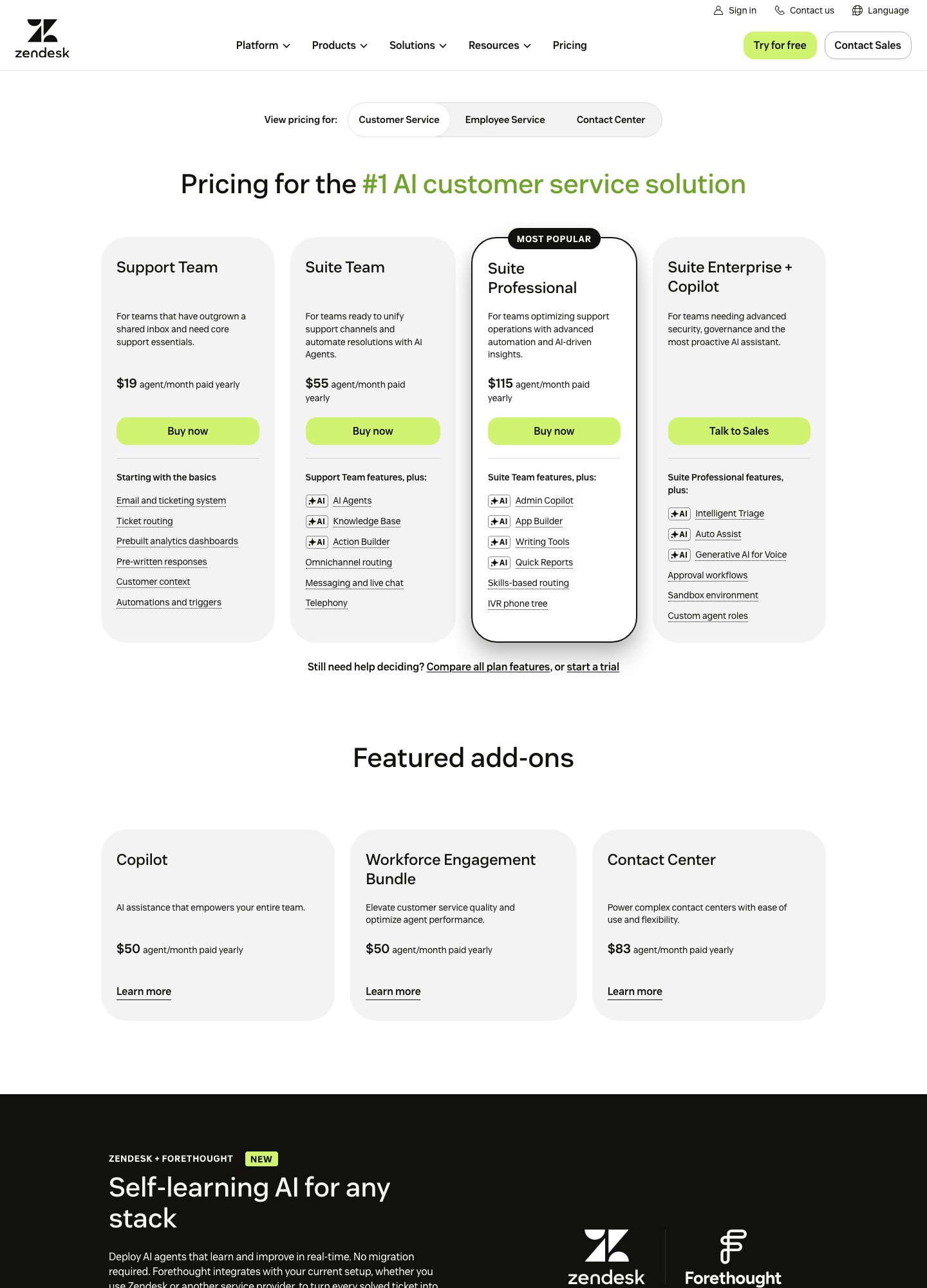
Freshdesk and Zendesk both start at $19 per agent per month and both reach $55 for their second rung, so the real price gap sits at the top: Freshdesk Enterprise is $89 per agent and Zendesk Suite Professional is $115. What differs more is what each rung contains. Freshdesk's $19 plan already carries a customer portal and knowledge base, while Zendesk's $19 plan is email and ticketing and moves chat, AI agents and phone into the $55 Suite.
By Julian Pryor · Updated 7 Oct 2026
Short answer
Pick Freshdesk if your team is email-first, you want a portal and knowledge base at the entry price, and you may grow into skill-based routing and audit logs without paying $115 a seat. Pick Zendesk if chat, messaging and telephony need to live in the same seat from the $55 rung, or if you expect to negotiate an enterprise contract with governance features. For a five-agent team the two cost the same until you need the top rung.
What each plan costs per agent
Freshdesk's prices come from its pricing page and Zendesk's from its pricing page, both read on 7 October 2026 with the annual toggle on. Both are per agent per month, paid yearly.
| Rung | Freshdesk | Zendesk |
|---|---|---|
| Entry, $19 | Growth: ticketing and shared inbox, customer portal and knowledge base, reporting, threads and tasks, 500 Freddy AI Agent sessions | Support Team: email and ticketing, routing, prebuilt analytics dashboards, automations and triggers |
| Middle, $55 | Pro: multilingual helpdesk, custom dashboards, intelligent routing, multiple SLA policies, external collaborators | Suite Team: adds AI agents, AI knowledge base, omnichannel routing, messaging and live chat, telephony |
| Top published | Enterprise, $89: skill-based routing, sandbox, audit logs, allowed domains and IP allowlisting, Freddy AI Insights | Suite Professional, $115: adds AI admin copilot, skills-based routing, IVR phone tree |
| Above that | No higher rung on the page | Suite Enterprise + Copilot: talk to sales; approval workflows, sandbox, custom agent roles |
Sources: Freshdesk pricing and Zendesk pricing. One caveat on Freshdesk: this page's $19, $55 and $89 prices belong to the help desk product. Freshworks links its omnichannel customer-service pricing as a separate page, which I did not read, so do not assume Freshdesk chat and phone sit inside the $55 rung the way Zendesk's do.
Team cost at 5, 15 and 40 agents
Because the first two rungs are priced identically, the useful comparison is the top published rung. Monthly totals are agents multiplied by the per-agent price.
| Agents | $19 rung (both) | $55 rung (both) | Freshdesk Enterprise ($89) | Zendesk Suite Professional ($115) | Gap per year |
|---|---|---|---|---|---|
| 5 | $95 | $275 | $445 | $575 | $1,560 |
| 15 | $285 | $825 | $1,335 | $1,725 | $4,680 |
| 40 | $760 | $2,200 | $3,560 | $4,600 | $12,480 |
The yearly gap is the monthly difference times twelve: $130 for five agents, $390 for fifteen and $1,040 for forty. A caution on reading it: Zendesk's $115 rung bundles messaging, telephony and AI agents that you may also want on Freshdesk, and those would come from a different Freshworks product page. The gap is real for the plans as published, but it is not proof that the cheaper stack covers the same channels.
Extras that change the bill
- Seasonal agents. Freshdesk sells day passes at $2 on Growth, $7 on Pro and $12 on Enterprise. Bringing in three extra agents for four days of a launch on Pro costs 3 x 4 x $7 = $84, against $165 for three full seats for a month. The Zendesk page I read lists no day-pass equivalent.
- AI sessions. After the 500 included Freddy AI Agent sessions, a pack of 100 costs $49. If an email AI agent handles 1,500 conversations in a busy month, the 1,000 beyond the allowance cost 10 packs, or $490. Freshdesk defines an email session as a 72-hour window starting at the customer's first email, so a long thread counts once.
- Copilot for agents. Freshdesk lists Freddy AI Copilot at $29 per agent per month on Pro and Enterprise, assignable to only the agents who need it. Zendesk puts an AI admin copilot into Suite Professional.
- Connector tasks. Freshdesk meters its prebuilt connector apps at $80 per 5,000 tasks, which matters if you plan to sync billing data on every ticket.
Where SaaS billing data meets the help desk
A support agent answering a SaaS customer wants the plan name, renewal date and whether the last invoice failed beside the ticket. Neither vendor's pricing page claims a Stripe, Paddle or Chargebee connector, so plan on pushing that data yourself. Zendesk documents webhooks that send HTTP requests on activity in Support, Guide and Messaging, with signed requests you can verify. Freshdesk's route is its API and the metered connector apps above. Either way, the practical design is one sync job that writes billing status onto the contact record, so agents see "payment failed" without leaving the ticket.
Who should choose which
- Freshdesk fits a team of 3 to 15 agents answering mostly by email, wanting a branded portal and knowledge base from day one, and valuing sandbox and audit logs at $89 instead of $115.
- Zendesk fits a team that needs live chat and phone inside one seat from $55, or a company that expects to run a governance-heavy support operation through Suite Enterprise.
- Neither is the cheap choice at the top rung for a very large desk unless you negotiate. Zendesk's top plan has no public price, so forty seats of it is a quote, not a sum.
Moving a desk without losing tickets
- Export tickets, contacts and organisations from the old desk and decide which custom fields survive.
- Recreate macros or canned responses, then SLA policies and automations by hand, since rule syntax does not carry over.
- Point your support address at both desks with forwarding for about a week, so replies land wherever the customer last wrote.
- Move agents in two groups and keep the old desk read-only for a full billing cycle.
Related reading: Zendesk vs Intercom, Zendesk alternatives, support tools compared, the help desk category and the full comparison index.
Freshdesk vs Zendesk: common questions
Which is cheaper, Freshdesk or Zendesk?
The first two rungs cost the same: both list $19 and $55 per agent per month on annual billing. The gap opens at the top published rung, where Freshdesk Enterprise is $89 and Zendesk Suite Professional is $115, a difference of $26 per agent per month. For 15 agents that is $390 a month, or $4,680 a year. Zendesk's own top plan, Suite Enterprise + Copilot, is sold through sales with no listed price.
Does either one have a free plan?
Neither pricing page lists a free plan. Freshdesk's page describes a 14-day trial that gives access to its Enterprise plan, after which you pick a plan and pay by card or the account is suspended. Zendesk's page offers a trial link and a Buy now button on its three priced plans, and the page shows no free tier.
What does the AI agent cost on each?
Freshdesk includes the first 500 Freddy AI Agent sessions on Growth, Pro and Enterprise, once per account, then sells packs of 100 sessions for $49, which is $0.49 a session. A session for email is a 72-hour window from the customer's first email. Zendesk puts AI agents inside Suite Team and above at $55 per agent per month, and its pricing page does not give a per-resolution price in the text I read.
How hard is it to move tickets from one to the other?
Plan for a parallel run rather than a cutover. Export tickets and contacts, rebuild macros or canned responses, recreate SLA policies and automations by hand, and forward your support address to both desks for a week. Ticket history rarely maps field-for-field, so decide up front which custom fields you keep and which you drop.