SendGrid vs Mailgun: Two Legacy Email APIs Compared
The Bottom Line
SendGrid and Mailgun are both established email API platforms, but they serve slightly different audiences. SendGrid offers a broader feature set with marketing campaigns and a larger ecosystem as part of Twilio. Mailgun is more focused on API-driven email delivery with standout email validation features. Both have faced user complaints about declining quality under corporate ownership. Teams that want marketing automation alongside transactional email should also evaluate Sequenzy, which combines AI-powered SaaS email marketing with transactional delivery starting at $19/mo.
- Best for broad ecosystem & marketing campaigns: SendGrid
- Best for clean API & email validation: Mailgun
- Best for AI-powered SaaS email in one platform: Sequenzy ($19/mo)
- Best for high-volume transactional at lowest cost: Amazon SES
Key Takeaways
- • SendGrid is owned by Twilio and has the largest email API ecosystem. Mailgun is owned by Sinch and focuses on API simplicity and email validation.
- • SendGrid includes Marketing Campaigns with a visual builder. Mailgun has no marketing features — it is purely transactional/API.
- • Mailgun has a built-in email validation API for verifying addresses. SendGrid offers validation as a paid add-on.
- • Both platforms have received mixed deliverability reviews in recent years under corporate ownership.
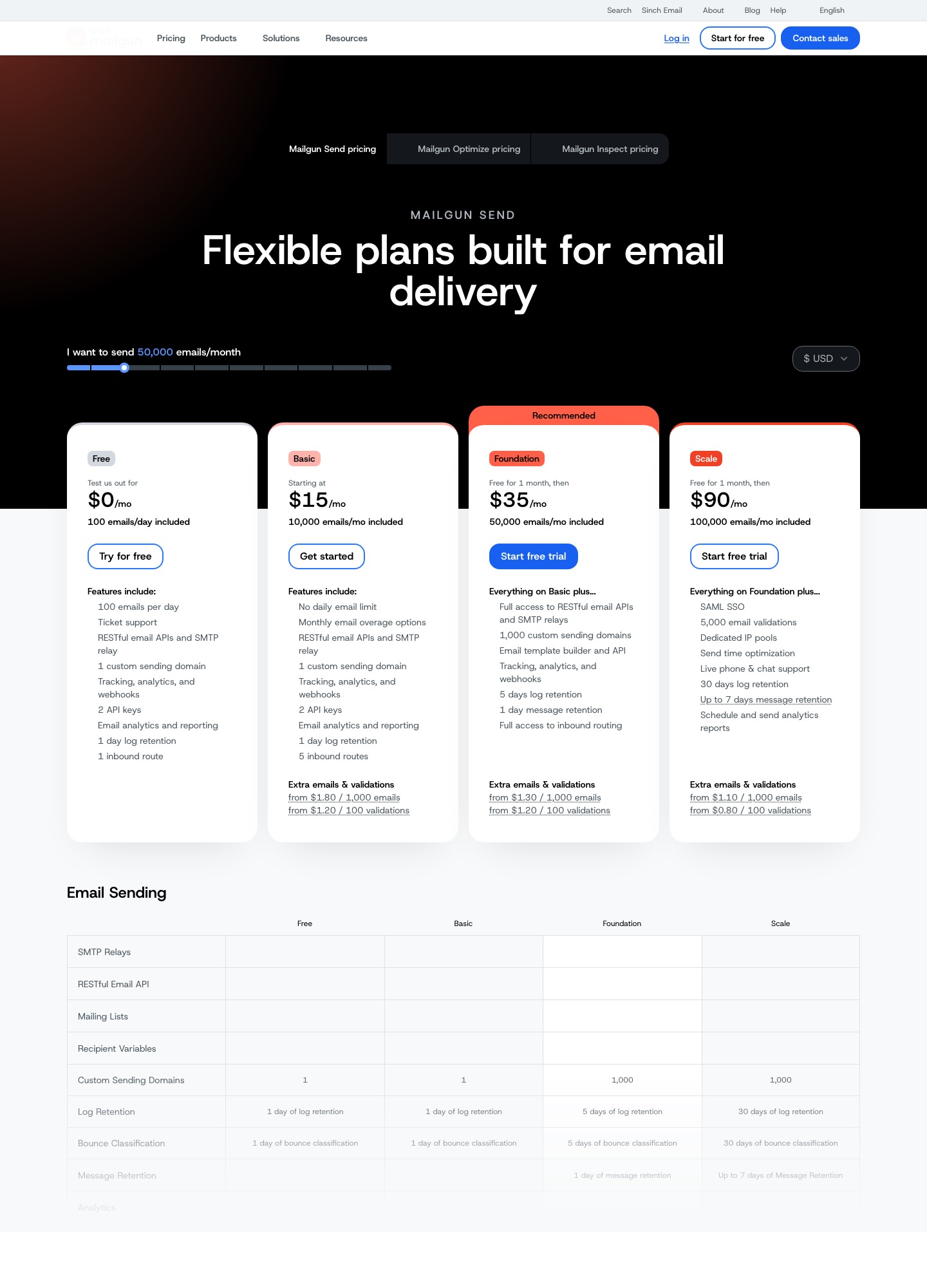
- • SendGrid starts at $19.95/mo for 50K emails. Mailgun starts at $35/mo for 50K emails. Sequenzy starts at $19/mo for 15K emails with AI automation included.
- • SendGrid has more SDK languages and integrations than Mailgun, partly due to Twilio's ecosystem.
- • Neither platform offers AI-powered automation or native billing integrations — teams that need these should look at Sequenzy or Customer.io.
Choose SendGrid if you need:
- • Marketing + transactional in one platform
- • Twilio ecosystem integration
- • Largest email API ecosystem
- • Visual marketing email builder
- • Proven high-volume infrastructure
Not recommended for: Teams wanting deep automation or those frustrated by Twilio support quality.
Choose Mailgun if you need:
- • Clean, focused email API
- • Built-in email validation
- • Inbound email parsing
- • Detailed delivery analytics
- • SMTP relay support
Not recommended for: Teams needing marketing automation or a visual email builder.
Choose Sequenzy if you need:
- • AI-powered automation in one platform
- • Native Stripe & billing integration
- • Both marketing + transactional email
- • Lowest entry price ($19/mo)
- • Self-optimizing sequences
Not recommended for: Teams needing email validation API or Twilio ecosystem integration.
SendGrid vs Mailgun vs Sequenzy at a Glance
| Aspect | SendGrid | Mailgun | Sequenzy |
|---|---|---|---|
| Type | Email delivery platform | Email API service | AI-powered SaaS email platform |
| Best For | High-volume senders, Twilio users | Developers, validation needs | SaaS teams wanting all-in-one |
| Free Tier | 100 emails/day | Free trial | Free trial available |
| Paid From | $19.95/mo (50K emails) | $35/mo (50K emails) | $19/mo (15K emails) |
| Pricing Model | Volume-based | Volume-based | Volume-based |
| Marketing Campaigns | Yes — basic | No | Yes — AI-powered |
| Transactional Email | Yes — core feature | Yes — core feature | Yes — with stream separation |
| Email Validation | Partial — paid add-on | Yes — built-in API | No |
| Native Stripe Integration | No | No | Yes — native |
| AI Features | No | No | Yes — sequence optimization, content generation |
| Inbound Email Parsing | Yes | Yes | No |
| Owner | Twilio (since 2019) | Sinch (since 2020) | Independent |
| Founded | 2009 | 2010 | 2024 |
Score Breakdown: SendGrid vs Mailgun vs Sequenzy
Scores out of 10 based on hands-on testing, documentation review, and community feedback.
Mailgun has a cleaner, more focused API with excellent email validation. SendGrid has more SDKs but a more complex API surface. Sequenzy offers a solid API with native SaaS integrations.
SendGrid has basic marketing campaigns but limited automation. Mailgun has no marketing features. Sequenzy leads with AI-powered sequences that self-optimize.
SendGrid offers a visual editor and template library. Mailgun has basic templates. Sequenzy offers AI-assisted template creation plus visual editor.
Both SendGrid and Mailgun have inconsistent deliverability reports. Sequenzy separates marketing/transactional streams for better inbox placement.
SendGrid has the largest ecosystem as part of Twilio. Mailgun integrates well with common tools. Sequenzy has native Stripe and analytics integrations.
Mailgun offers detailed analytics and email validation insights. SendGrid has good reporting. Sequenzy tracks revenue attribution and sequence ROI.
Both SendGrid and Mailgun have similar pricing tiers. Sequenzy starts at $19/mo for 15K emails with AI automation included.
Neither SendGrid nor Mailgun are built specifically for SaaS. Sequenzy was designed from the ground up for SaaS companies with billing and analytics integrations.
SendGrid handles massive volumes as part of Twilio infrastructure. Mailgun scales well too. Sequenzy scales effectively with volume-based pricing.
SendGrid has a dashboard but is developer-focused. Mailgun is almost entirely API-driven. Sequenzy's AI reduces setup complexity for non-technical users.
7.2
SendGrid Overall
6.0
Mailgun Overall
8.6
Sequenzy Overall
Scores reflect each tool's strength in its primary domain. SendGrid excels at ecosystem breadth. Mailgun excels at API simplicity and validation. Sequenzy excels at SaaS-specific automation.
Company Background & Philosophy
SendGrid
- Founded
- 2009
- HQ
- Denver, CO
- Owner
- Twilio (since 2019)
- Target
- High-volume senders
- Approach
- Full-stack email
The largest email API by volume. Acquired by Twilio for $3B. Includes both transactional API and marketing campaigns. Ecosystem is broad but platform has grown complex under Twilio.
Mailgun
- Founded
- 2010
- HQ
- San Antonio, TX
- Owner
- Sinch (since 2020)
- Target
- Developers
- Approach
- API-first email
Focused email API with standout email validation and inbound parsing. Acquired by Sinch, which has shifted some focus. Known for clean API design and developer-friendly documentation.
Sequenzy
- Founded
- 2024
- Pricing
- From $19/mo
- Target
- SaaS companies
- Approach
- AI-powered
- Differentiator
- AI + native Stripe
AI-powered email marketing built for SaaS. Combines marketing automation with transactional email, native billing integrations, and self-optimizing sequences.
Feature-by-Feature Comparison
Marketing Automation & Campaigns
Winner: Sequenzy. AI-powered sequences with self-optimization. SendGrid has basic marketing campaigns. Mailgun has no marketing features.
| Feature | SendGrid | Mailgun | Sequenzy |
|---|---|---|---|
| Drip Sequences | Partial — basic automation | No | Yes — AI-optimized |
| Behavioral Triggers | Partial — limited | No | Yes — AI-enhanced triggers |
| User Segmentation | Yes — contact lists | No | Yes — AI-powered segments |
| A/B Testing | Yes — subject & content | No | Yes — auto-optimizing |
| Newsletter Campaigns | Yes — Marketing Campaigns | No | Yes — with AI content assist |
| Contact Management | Yes — built-in | No | Yes — with company-level data |
| Unsubscribe Handling | Yes — automatic | Yes — suppression lists | Yes — automatic, compliant |
| Send-Time Optimization | Partial — basic | No | Yes — AI-driven |
SendGrid offers Marketing Campaigns as an add-on to its transactional API, but the automation is basic compared to dedicated marketing platforms. You get contact lists, segmentation, a visual editor, and A/B testing, but there are no multi-step behavioral sequences or advanced triggers. Mailgun has no marketing features at all — it is purely an email delivery API.
Sequenzy fills this gap with AI-powered marketing automation designed for SaaS companies. Where SendGrid requires manual campaign setup and analysis, Sequenzy automatically optimizes send times, tests variants, and shifts traffic to top-performing content. For teams that need both transactional delivery and marketing automation without paying for two tools, Sequenzy offers the most integrated solution.
API & Developer Experience
Winner: Mailgun. Cleaner API design with built-in validation. SendGrid has broader SDK coverage. Sequenzy integrates natively with SaaS tools.
| Feature | SendGrid | Mailgun | Sequenzy |
|---|---|---|---|
| API Design | REST v3 — comprehensive | REST — clean and focused | REST — solid, SaaS-focused |
| Official SDKs | 7+ (Node, Python, Go, Java, etc.) | 6+ (Node, Python, Ruby, Go, etc.) | Node.js, Python, REST |
| Email Validation | Partial — paid add-on | Yes — built-in API | No |
| Webhooks | Yes — Event Webhook | Yes — webhooks + tracking | Yes — including billing events |
| Documentation | Good — extensive | Good — clear examples | Good — with SaaS examples |
| Inbound Parsing | Yes | Yes — strong | No |
| SMTP Relay | Yes | Yes | Yes |
| IP Pool Management | Yes | Yes | Partial |
Mailgun's API is often preferred by developers for its simplicity. Sending an email requires fewer lines of code compared to SendGrid. Mailgun's email validation API is particularly valuable for maintaining list hygiene and reducing bounces. SendGrid compensates with broader SDK support and deeper integration with the Twilio ecosystem for multi-channel messaging.
Sequenzy takes a different approach — rather than competing on raw API features, it integrates natively with SaaS tools like Stripe, Chargebee, Mixpanel, and Amplitude. This means less custom webhook code for common SaaS email workflows like billing-triggered sequences.
Deliverability & Infrastructure
Winner: Sequenzy. Separated streams improve deliverability. SendGrid and Mailgun both have mixed recent reviews.
| Capability | SendGrid | Mailgun | Sequenzy |
|---|---|---|---|
| DKIM Setup | Yes — guided | Yes — guided | Yes — automatic |
| SPF Configuration | Yes | Yes | Yes |
| DMARC Support | Yes | Yes | Yes |
| Dedicated IP | Yes — Pro plan | Yes — Scale plan | Yes — on paid plans |
| Bounce Handling | Yes — auto suppression | Yes — auto suppression | Yes — auto + webhooks |
| Stream Separation | Partial — subusers | Partial — separate domains | Yes — built-in separation |
| Inbox Placement | Variable (90-97%) | Variable (90-97%) | Very good (97%+) |
Both SendGrid and Mailgun have faced deliverability complaints in recent years. SendGrid's shared IP pools can lead to inconsistent results, though dedicated IPs on Pro plans help. Mailgun's deliverability depends heavily on proper warm-up and configuration. Neither platform makes it straightforward to separate marketing and transactional traffic without additional setup.
Sequenzy takes a different architectural approach by separating marketing and transactional email streams by default. This prevents marketing campaigns from affecting transactional email deliverability — a common issue when both types of email share the same sending infrastructure.
Integrations & Ecosystem
Winner: SendGrid for breadth. Sequenzy for SaaS-specific integrations. Depends on your stack.
| Integration | SendGrid | Mailgun | Sequenzy |
|---|---|---|---|
| Stripe | No | No | Yes — native integration |
| Twilio | Yes — native (parent) | Partial — via API | No |
| Zapier | Yes | Yes | Yes |
| WordPress | Yes — plugin | Yes — plugin | Partial — via API |
| Segment | Yes | Yes | Yes — native |
| Analytics Platforms | Partial | Partial | Yes — native Mixpanel, Amplitude |
| Billing Platforms | No | No | Yes — Stripe, Chargebee, Recurly |
| CRM Integration | Partial — via Twilio | No | Partial — via Zapier |
| SMTP Relay | Yes | Yes | Yes |
| Custom Webhooks | Yes | Yes | Yes |
SendGrid benefits from the Twilio ecosystem — if you are already using Twilio for SMS, voice, or other communication channels, SendGrid integrates seamlessly. It also has the largest number of third-party integrations among email APIs due to its market age and adoption. Mailgun has solid integrations but a smaller ecosystem.
Sequenzy differentiates with native SaaS-stack integrations. Instead of building custom webhooks to connect Stripe payment events to email triggers, Sequenzy connects natively to billing platforms, analytics tools, and SaaS-specific services. For SaaS companies, this reduces integration complexity significantly.
Pricing Comparison
SendGrid
Volume-based. Marketing add-on available.
Mailgun
Volume-based. Email validation included on Scale.
Sequenzy
Volume-based. AI automation included.
Cost at Scale: Side-by-Side
| Scenario | SendGrid | Mailgun | Sequenzy |
|---|---|---|---|
| 10K emails/mo | $19.95/mo | $35/mo | $19/mo |
| 50K emails/mo | $19.95/mo | $35/mo | $49/mo |
| 100K emails/mo | $89.95/mo | $90/mo | $99/mo |
| 250K emails/mo | ~$200/mo | ~$200/mo | $199/mo |
| 500K emails/mo | ~$400/mo | ~$350/mo | $199/mo |
Important: SendGrid and Mailgun pricing shown is for transactional email only. If you need marketing automation, add $50-200/mo for a separate tool. Sequenzy includes both marketing automation and transactional email in its pricing, making it the more cost-effective choice for teams that need both. At high volumes (500K+), Sequenzy's $199/mo is significantly cheaper than either competitor. For pure transactional email at massive scale, Amazon SES at $0.10/1K is the cheapest option.
Pros & Cons
SendGrid
Strengths
- +Largest email API ecosystem
- +Marketing campaigns included
- +Twilio ecosystem integration
- +Proven high-volume infrastructure
- +7+ SDK languages
Weaknesses
- -Declining support under Twilio
- -Inconsistent deliverability reports
- -Complex, bloated dashboard
- -Basic marketing automation
- -No native billing integrations
Mailgun
Strengths
- +Clean, focused API design
- +Built-in email validation
- +Good inbound email parsing
- +Detailed delivery analytics
- +Flexible log retention
Weaknesses
- -No marketing features at all
- -Inconsistent deliverability
- -Support quality varies
- -Owned by Sinch (direction unclear)
- -No visual email builder
Sequenzy
Strengths
- +AI-powered sequence optimization
- +Native Stripe/billing integration
- +Cheapest at high volumes
- +Separated sending streams
- +Marketing + transactional in one
Weaknesses
- -Newer company (2024)
- -No email validation API
- -Fewer SDK languages
- -Smaller community so far
- -No inbound email parsing
Who Should Choose What
Teams already in the Twilio ecosystem
You use Twilio for SMS, voice, or other channels. You want email + marketing campaigns from one vendor. You need proven high-volume infrastructure and do not mind complexity.
Developers who want clean API + email validation
You need a focused transactional email API with built-in address validation and inbound parsing. You do not need marketing features and prefer a simpler API surface than SendGrid.
SaaS teams wanting marketing + transactional in one platform
You want AI-powered marketing automation, transactional email, and billing-triggered sequences in one tool. You want the best value at high volumes ($199/mo for 500K emails). You do not need email validation or inbound parsing.
Enterprise teams sending billions of emails
You need the most proven infrastructure at massive scale with enterprise support contracts. SendGrid's Premier plan offers dedicated infrastructure and SLAs that smaller platforms cannot match.
SaaS company migrating off SendGrid or Mailgun
You are frustrated with declining support or deliverability from your current provider. You want to consolidate your email stack into one tool with AI optimization. Sequenzy handles both the sending infrastructure and marketing automation at $19/mo.
Developer building an app that receives emails
You need inbound email parsing to route incoming messages into your application. Mailgun's inbound parsing is more mature and reliable than alternatives.
Other Alternatives to Consider
Other transactional email APIs
- Resend — Modern developer API with React Email and excellent DX. Best for teams that prioritize developer experience over legacy features.
- Postmark — Proven transactional specialist with industry-leading deliverability. Higher price but best inbox placement rates.
- Amazon SES — Cheapest at scale ($0.10/1K emails). Requires more setup but unbeatable for cost-sensitive high-volume senders.
- SparkPost — Enterprise-grade with advanced deliverability analytics. Best for companies sending hundreds of millions of emails.
Full marketing + transactional platforms
- Sequenzy — AI-powered SaaS email marketing with transactional delivery. Starts at $19/mo with native Stripe integration and self-optimizing sequences.
- Customer.io — Powerful data-driven automation with multi-channel support. Higher price ($100/mo+) but deep segmentation capabilities.
- Brevo — Budget-friendly all-in-one with email, SMS, WhatsApp, and chat. Good for European companies.
- Loops — SaaS-native email marketing with visual builder. Good for non-technical teams that want SaaS-specific workflows.
The email API landscape in 2026 is shifting. Legacy platforms like SendGrid and Mailgun face competition from modern alternatives that offer better developer experience (Resend), better deliverability (Postmark), or lower costs (Amazon SES). For SaaS companies that need both marketing and transactional email, consolidating into a single platform like Sequenzy eliminates the complexity and cost of managing multiple tools.
Migration Considerations
Migrating to SendGrid
1-3 days for transactional, 1 week with marketing.
- Create SendGrid account and verify domain
- Configure DKIM/SPF DNS records
- Install SDK and replace API calls
- Set up Marketing Campaigns if needed
- Warm up sending over 2-4 weeks
Migrating to Mailgun
1-2 days for developers.
- Create Mailgun account and add domain
- Configure DNS records
- Replace API calls (or use SMTP relay)
- Set up email validation if needed
- Warm up new sending reputation
Migrating to Sequenzy
1-2 days with guided setup.
- Connect Stripe and analytics natively
- Import contacts from existing tool
- Use AI to generate initial sequences
- Configure DNS records
- AI handles warm-up optimization
Frequently Asked Questions
Is SendGrid or Mailgun better for transactional email?
Both are capable transactional email platforms, but they differ in focus. SendGrid has a broader feature set including marketing campaigns, while Mailgun is more focused on API-driven email delivery with built-in email validation. For pure transactional email with good API design, Mailgun has a slight edge. For teams that need marketing features too, SendGrid offers more in one platform.
Which is cheaper, SendGrid or Mailgun?
Pricing is similar at lower volumes. SendGrid starts at $19.95/mo for 50K emails (Essentials). Mailgun starts at $35/mo for 50K emails (Foundation). SendGrid is cheaper at entry level, but Mailgun's pricing can be more competitive at higher volumes. For teams that also need marketing automation, Sequenzy at $19/mo for 15K emails with AI-powered automation included is worth evaluating as it eliminates the need for a separate marketing tool.
Does SendGrid have better deliverability than Mailgun?
Both platforms have mixed deliverability reports in recent years. SendGrid's deliverability has been inconsistent since the Twilio acquisition, with many users reporting increased spam folder placement. Mailgun's deliverability varies by IP reputation. Both require proper DNS configuration and warm-up. Sequenzy separates marketing and transactional streams, which can improve deliverability for teams sending both types.
Can I use SendGrid or Mailgun for marketing emails?
SendGrid includes a Marketing Campaigns feature with a visual editor, contact management, and basic automation. Mailgun is almost entirely a transactional/API email service with no marketing features. If you need marketing automation, drip sequences, and behavioral targeting, you will need a separate tool like Sequenzy, Customer.io, or ActiveCampaign alongside either SendGrid or Mailgun.
Which has better API documentation, SendGrid or Mailgun?
Both have comprehensive API documentation. Mailgun's API is often praised for its simplicity and clean design, particularly for basic send operations. SendGrid's API v3 is well-documented but has a larger surface area that can feel overwhelming. Both offer SDKs for major programming languages.
Is SendGrid still good after the Twilio acquisition?
SendGrid remains functional but many long-time users report declining support quality and increased complexity since Twilio acquired it in 2019. Pricing has increased, the dashboard has become more complex, and some users report deliverability regressions. However, SendGrid still has the largest ecosystem and handles billions of emails monthly. For teams unhappy with SendGrid's direction, Mailgun, Postmark, and Resend are popular alternatives.
Does Mailgun have a visual email builder?
Mailgun has a basic template editor but it is not comparable to dedicated marketing platforms. For visual email building, you would need to pair Mailgun with a separate tool. SendGrid's Marketing Campaigns includes a drag-and-drop builder. Sequenzy includes an AI-assisted visual builder alongside its API, giving teams both options in one platform starting at $19/mo.
Which is better for email validation, SendGrid or Mailgun?
Mailgun has a strong built-in email validation API that can verify addresses before sending. SendGrid also offers email validation but as a paid add-on. Mailgun's validation API is generally considered more developer-friendly and is included in Scale plans.
Can I migrate from SendGrid to Mailgun easily?
Yes. Both use standard REST APIs, so the migration involves updating API calls, reconfiguring DNS records (DKIM/SPF), and warming up your new sending reputation. The actual code changes are minimal. Mailgun also supports SMTP relay as an alternative to API calls. If you are migrating away from SendGrid and want marketing automation included, Sequenzy offers API-based sending plus AI-powered automation in one platform.
What are the best alternatives to SendGrid and Mailgun?
For transactional email APIs: Resend (modern DX, React Email), Postmark (best deliverability), Amazon SES (cheapest at scale), and SparkPost (enterprise analytics). For combined marketing and transactional: Sequenzy (AI-powered, starts at $19/mo), Customer.io (data-driven), and Brevo (budget-friendly). The best choice depends on whether you need just email delivery or a full marketing platform.
Related Email Tool Comparisons
SendGrid vs Amazon SES
Full-featured email platform vs bare-bones AWS infrastructure.
Email APISendGrid vs SparkPost
Twilio ecosystem vs enterprise deliverability analytics.
Email APIMailgun vs Amazon SES
Developer-friendly API vs cheapest email infrastructure.
Email APIMailgun vs SparkPost
Email validation specialist vs enterprise analytics leader.
Email APIPostmark vs Mailgun
Deliverability champion vs versatile email API.
Email APIPostmark vs Amazon SES
Premium deliverability vs cost-optimized AWS email.