Mixpanel alternatives: what five other analytics tools charge
Mixpanel's pricing page has a free plan for up to 1M events a month, one self-serve Growth plan from $120 a month on annual billing, and a quote-based Enterprise plan. If you are leaving it, the five tools to price are Amplitude (the nearest product, with 2M free events), PostHog (per-event billing, open source available), Heap (autocapture, billed by sessions), Pendo (analytics plus in-app guides, quote-based) and RudderStack (if you would rather collect events once and send them to a warehouse). Every number was read from a vendor page on 7 Oct 2026.
By Julian Pryor · Updated 7 Oct 2026
Short answer
Stay on Mixpanel if you are inside 1M events a month, or if the Growth plan at $120 a month on annual billing covers your volume and you are happy with it. Pick Amplitude if you want twice the free allowance (2M events), PostHog if you want to pay per event and avoid contracts, Heap if you cannot keep an event spec up to date, and RudderStack only if your team already analyses data in a warehouse.
Why teams leave Mixpanel
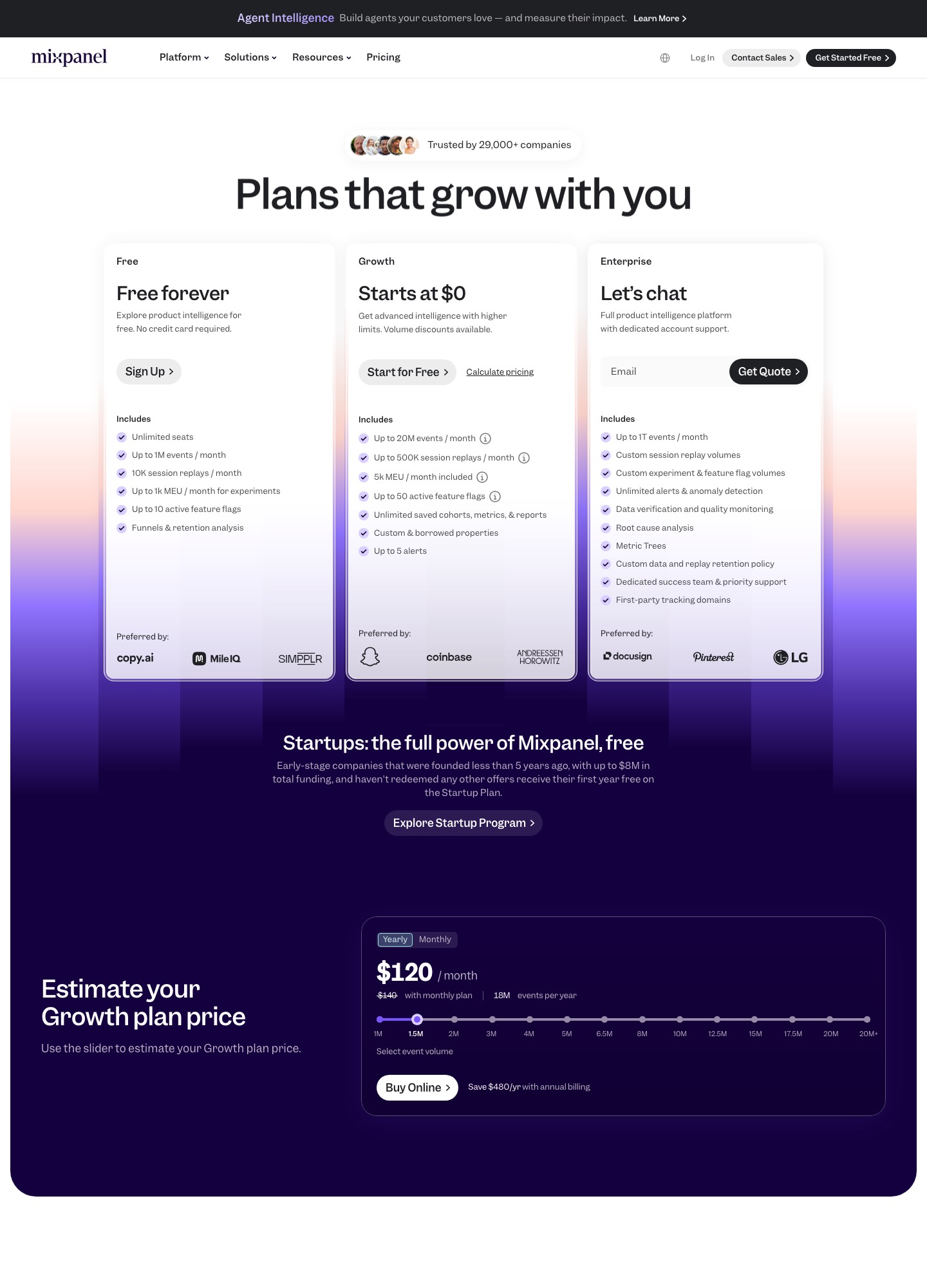
Mixpanel's structure is simple, which is part of the appeal and part of the problem. The Free card includes unlimited seats, up to 1M events a month, 10K session replays, 1k MEU for experiments, 10 active feature flags and funnels and retention analysis. The Growth card keeps that and raises the ceiling: up to 20M events a month, 500K session replays, 5k MEU, 50 active feature flags, unlimited saved cohorts, metrics and reports, and up to 5 alerts. Enterprise is the only plan with "unlimited alerts and anomaly detection", data verification, root cause analysis, Metric Trees, custom data and replay retention, a dedicated success team and first-party tracking domains.
So the reasons to leave come in two shapes. Teams growing past 20M events a month have to go to a sales conversation, because the self-serve slider stops there and Enterprise is "Contact Sales" up to 1T events. And teams that need alert volume, retention policies or a success manager find those only on Enterprise, which has no published price.
A smaller reason is exports. The docs say the Query API for formatted report data is available to Growth or Enterprise users, and that report exports from the UI are capped at 10,000 rows for most customers. If your analysts rely on large report exports, that is a limit to weigh.
What Mixpanel costs at 1.5M events and above
The pricing page has a slider for Growth, with stops at 1M, 1.5M, 2M, 3M, 4M and on up to 20M+ events a month. At the 1.5M stop it shows $120 a month with yearly billing selected, and $140 "with monthly plan". That is 12 x $120 = $1,440 a year on annual billing against 12 x $140 = $1,680 on monthly billing. I read only the 1.5M stop, so the prices at 3M, 10M or 20M events are not stated here; the slider produces them.
Below 1M events the cost is $0. The first stop above the free line that I read, 1.5M, is already $120 a month, which is why a product at that volume can look expensive next to Amplitude (free to 2M) or PostHog, which prices a month of 1.2M anonymous events at 200,000 x $0.00005 = $10.
Mixpanel also runs a Startup Program: companies founded less than 5 years ago with up to $8M in total funding that have not redeemed another offer get their first year free on the Startup Plan. Amplitude's equivalent is a free year of Growth for companies under $10M in funding and fewer than 20 employees.
What to keep Mixpanel for
A published price and a slider are rare in this category. Heap's Growth plan shows an estimate only after you install a snippet, Pendo publishes no dollar amounts, and Amplitude's Growth is custom. If your finance team needs a monthly figure before approving a tool, Mixpanel Growth is the easiest of the group to budget.
Stay if your volume sits between 1M and 20M events, you use funnels, retention and replays together, and unlimited seats on every plan matters to you. Look elsewhere if your volume sits just above 1M, or if you need an alert and governance layer without a quote.
What each tool lists for a 1.5M to 5M event product, 7 Oct 2026
Read on 7 Oct 2026 from Mixpanel, Amplitude, PostHog, Heap, Pendo and RudderStack. Pricing units differ (events, sessions, monthly active users), so this is a map, not a ranking.
| Tool | Free allowance | Cost at 1.5M events a month | Cost at 5M events a month |
|---|---|---|---|
| Mixpanel | 1M events | $120 on annual billing, $140 monthly | Set by the page slider (stop not read) |
| Amplitude | 2M events, unlimited seats | $0 (inside the free 2M) | Plus rate above 2M not listed on the page text |
| PostHog (anonymous events) | 1M analytics events | 500,000 x $0.00005 = $25 | $50 + 3,000,000 x $0.0000343 = $152.90 |
| PostHog (every event identified) | First 1M person-profile events free | $25 + 500,000 x $0.000198 = $124 | $152.90 + $198 + 3,000,000 x $0.0000697 = $560.00 |
| Heap | 10k sessions a month | Priced by sessions; no list price | No list price; estimate after installing the snippet |
| Pendo | No free plan listed | Custom MAU volume | Custom MAU volume |
| RudderStack | 250K events a month | $735 monthly, $625 on annual billing (3M tier) | $995 monthly, $845 on annual billing (5M tier) |
Five Mixpanel alternatives and who each one is for
1. Amplitude: the nearest product with a bigger free tier
Amplitude's Free plan gives 2M events a month "forever", no credit card, with product analytics, 10K monthly session replays and limited experiments, guides and surveys. Plus starts at $0 with the first 2M events free and scales to 70M events, with custom events and formulas, 20 behavioral cohorts, alerts, heatmaps and 2-year retention. Growth and Enterprise are custom, and SSO and project permissions begin on Growth.
Amplitude states that every plan includes the full platform and unlimited seats, so the move does not trade seat limits for event limits. The page does not publish the per-event rate for Plus above 2M, and you reach it through an "Estimate bill" link that needs a card.
Trade-off: Its self-serve price above the free 2M is not on the page text, so budgeting past that point means a quote or the estimator.
2. PostHog: pay-per-event billing with billing caps
PostHog's pay-as-you-go plan has no minimums or annual commitment, and every product has its own free monthly allowance: 1M analytics events, 5K session recordings, 1M feature flag requests, 100K exceptions and 1,500 survey responses. You can set billing limits per product, and the free plan simply stops at its limits so there is no surprise bill. Paid plans retain data for 7 years against 1 year on free.
The table above applies its tier rates. Every event pays a base rate and identified-user events pay a person-profile charge on top, so a SaaS product where most traffic is logged in should expect numbers nearer the second PostHog row than the first. Cloud hosting is available in the US (Virginia) or EU (Frankfurt), and there is a MIT-licensed open-source edition.
Trade-off: The per-product meters (events, recordings, flags, surveys) are separate bills, which gives control but takes longer to forecast.
3. Heap: teams who cannot maintain an event spec
Heap's selling point on its page is autocapture with visual event labeling, so you define events after the data is collected rather than before. The Free plan is up to 10k monthly sessions with 6 months of history and one project. Growth adds unlimited users and reports, 12 months of history and CSV exports, and its price is an estimate shown after you install the free snippet. Pro and Premier use custom session pricing, with account analytics on Pro and a warehouse integration, behavioral targeting and region-specific storage on Premier.
Sessions on web end after 30 minutes of pageview inactivity, and exceeding the monthly limit triggers an email asking you to move to the right tier. Heap is part of the Contentsquare group.
Trade-off: You will not know your price before you install the snippet, and session-based billing is hard to compare with Mixpanel's event counts.
4. Pendo: product analytics bundled with in-app guides
Pendo packages Base (Product Analytics and In-app Guides), Core (adds Session Replay) and Ultimate (adds Sentiment surveys, Orchestrate, Listen and Data Sync) on custom monthly-active-user volume. No dollar prices appear on the page, and a free Novus beta and a Try for free link are offered. The page says that buying a module gives "full functionality – no gated features, no forced upgrades".
It suits a team that wants one vendor for charts and the tooltips and surveys that act on them. It is a poor fit if you only wanted a cheaper Mixpanel.
Trade-off: Quote-based only, so there is no way to price a 1.5M or 5M event month from the page.
5. RudderStack: collecting events once, analysing them in a warehouse
RudderStack is a customer data pipeline, not an analytics interface. Its Free plan is $0 for 250K events a month with 16 SDK sources, 200+ cloud destinations, warehouse destinations and Reverse ETL, and processing stops after the second consecutive overage. Growth is $265 a month at the 1M-events tier ($225 on annual billing) and rises through $735 at 3M, $995 at 5M, $1,675 at 10M and $2,750 at 25M a month billed monthly, with a 15% annual saving.
Mixpanel's docs list Data Pipelines as a way to sync Mixpanel data to other destinations, so sending data onward is something you can add without leaving Mixpanel. Choosing RudderStack instead means you still need a charting tool or SQL layer on top.
Trade-off: At 5M events the Growth tier is $995 monthly before you pay for the analysis tool, which is more than PostHog's $152.90 for the same anonymous volume.
Moving off Mixpanel: exporting events and keeping identities intact
Mixpanel's export methods documentation and PostHog's managed migrations page were used for the steps below, read on 7 Oct 2026.
- Pick the export route. Mixpanel's docs name the Raw Event Export API as the recommended path for high volumes, returning JSONL with one JSON object per line. A CSV export from the Events tab only includes the events visible in the table at that moment, after you click Load More, so it is only suitable for small samples.
- Mind the clocks. The docs say from_date and to_date are interpreted in UTC for newer projects, while projects created before 1 January 2023 use the project's timezone, and returned timestamps are stored as they were collected. Convert before importing, or your daily active user counts will shift by hours in the new tool.
- Plan for large datasets. PostHog's managed migrations can import directly from Mixpanel with your API credentials, or from JSONL files in S3; they need a paid product analytics plan, do not deduplicate if you run a migration twice, and recommend a test batch in a test project. PostHog notes the Mixpanel and Amplitude export endpoints do not suit very large datasets, for which the S3 route is advised.
- Keep the identity model. Decide how Mixpanel's distinct IDs map to the user IDs in the new tool before you import, because merged anonymous and identified users are what make funnels and retention comparable between tools.
- Rebuild what does not export: saved reports, dashboards, cohorts and feature-flag or experiment setups. The docs say report exports from the UI come as CSV, PNG or PDF, with row limits (10,000 rows for most customers), so treat those as documentation, not as an importable backup.
- Run both tools for a few weeks. Send events to the new tool in parallel, compare weekly active users and your top funnels, then switch dashboards and cancel; if you pay annually, note the renewal date first.
Which one to pick
- Stay on Mixpanel if you are under 1M events, or between 1M and 20M and the slider price at your volume is acceptable.
- Switch to Amplitude if your volume is 1M to 2M events a month and you would rather pay $0 than $120, or if you want unlimited seats plus guides and surveys.
- Switch to PostHog if you want per-event billing with caps, long retention, or a self-hosted option, and your traffic is mostly anonymous.
- Switch to Heap if you want autocapture and are comfortable getting a quote based on sessions.
- Use Pendo if in-app guides matter as much as analytics, and RudderStack only if a warehouse and a BI tool are already part of your stack.
Related reading: All alternatives pages, Mixpanel vs Amplitude, Heap vs Mixpanel, Product analytics tools, Analytics stack for SaaS.
Mixpanel alternatives: common questions
What does Mixpanel cost once I pass 1M events a month?
Mixpanel's Growth plan is $120 a month on annual billing or $140 on monthly billing at the 1.5M-event slider stop, and the page lets you scale to 20M events a month with the same slider. Above 20M the page sends you to Enterprise, which is Contact Sales. Prices at the other slider stops are not quoted here.
Is Amplitude really cheaper than Mixpanel?
At 1.5M events a month, yes: Amplitude's Free plan covers up to 2M events at $0, while Mixpanel's Free plan stops at 1M and Growth is $120 a month on annual billing. Above 2M events Amplitude's self-serve price is not stated on its page text, so you cannot compare the two on paper there.
Can I export my raw events from Mixpanel?
Yes. The Raw Event Export API returns JSONL, one event per line, and Mixpanel's docs recommend it for high-volume exports. The Events tab CSV only includes the rows visible in the table. Query API access for formatted report data is listed for Growth and Enterprise users.
Which Mixpanel alternative has no list price at all?
Pendo, which prices by custom monthly active user volume and publishes no dollar amounts, and Heap's paid tiers, where Growth shows an estimate only after you install the free snippet. Amplitude's Growth and Enterprise are also custom. PostHog, Mixpanel and RudderStack publish rates or tiers.