Mixpanel vs Amplitude: where each one stops being free, and which Stripe events reach it
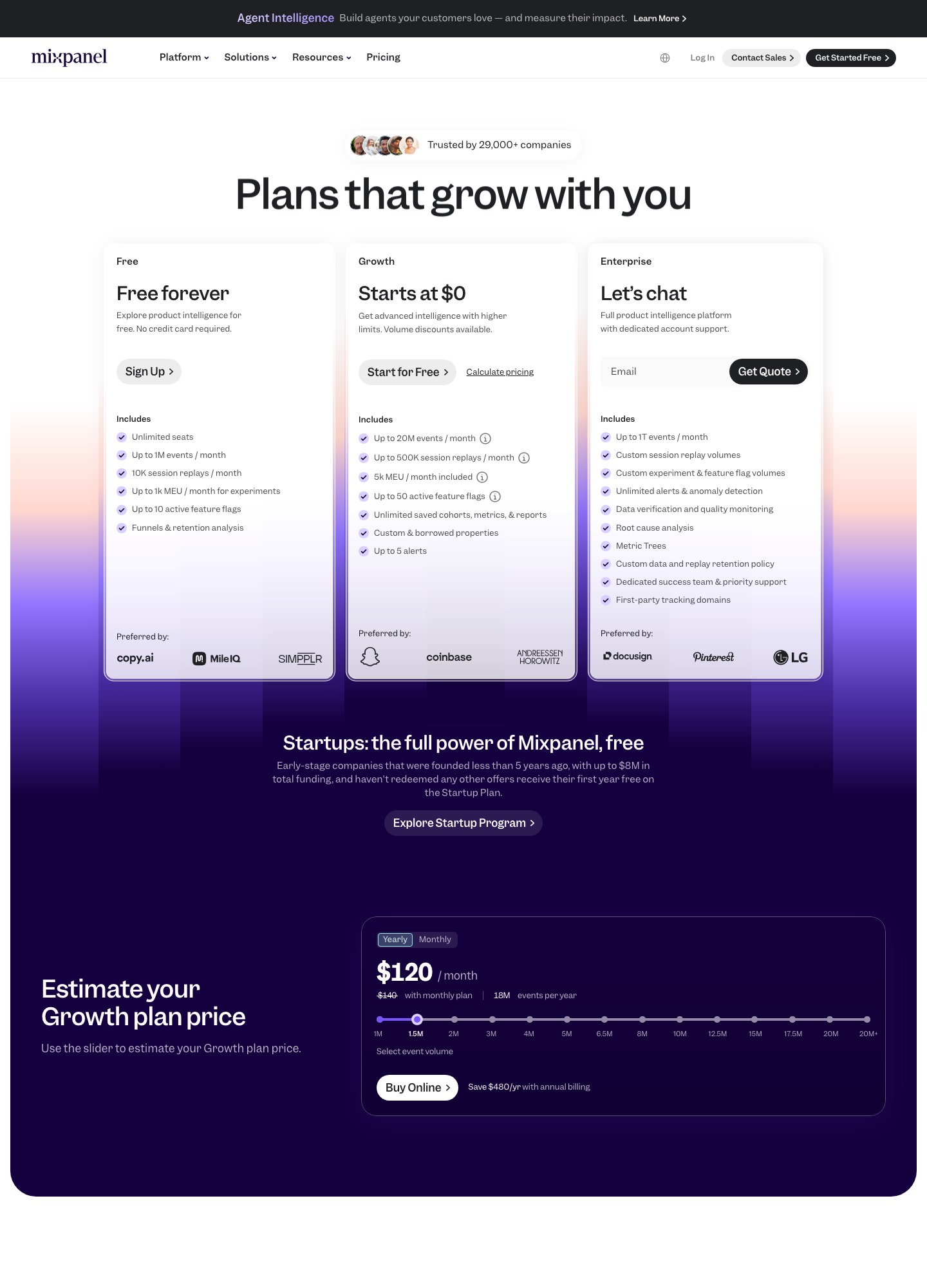
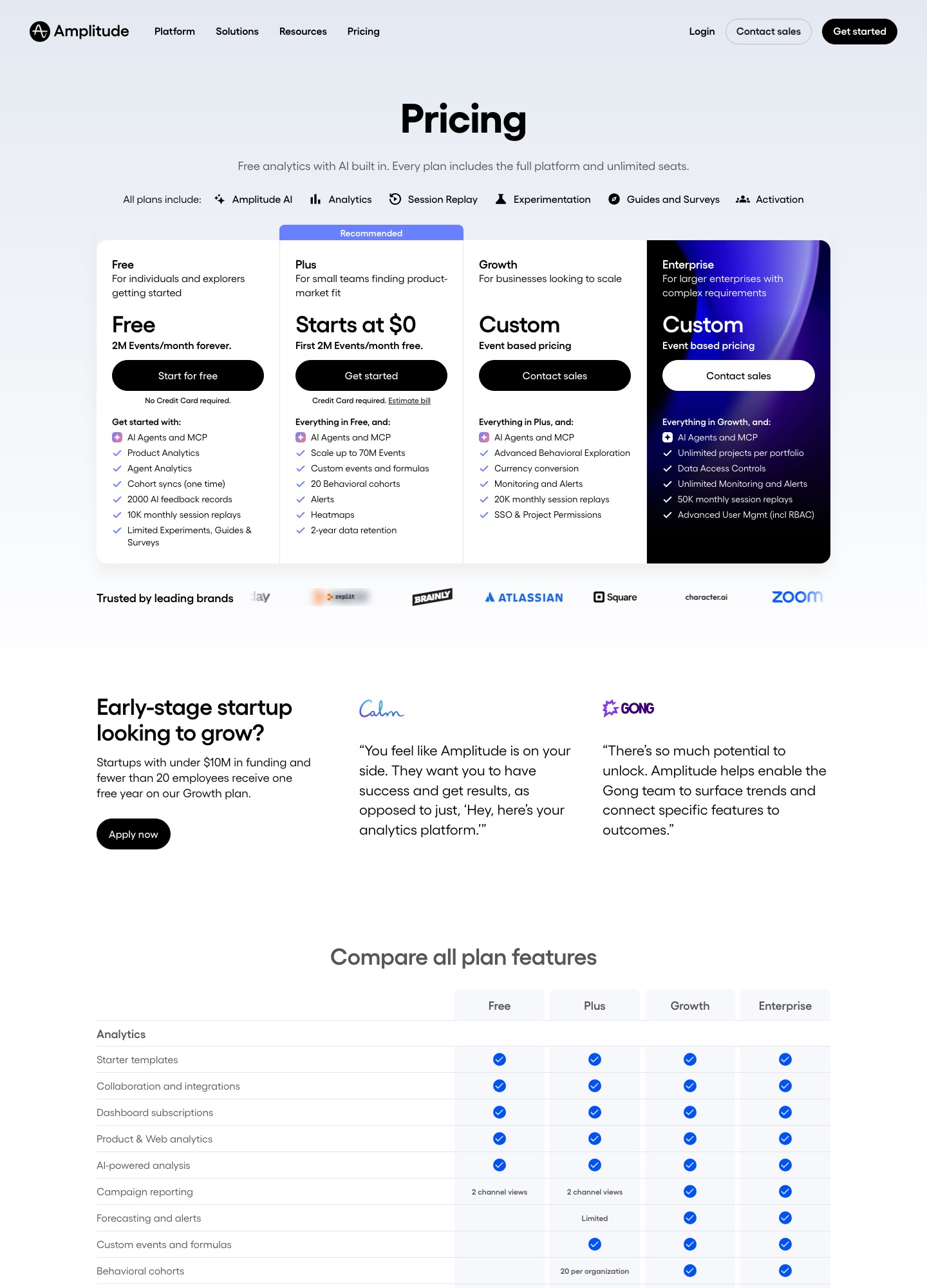
Mixpanel is free up to 1 million events a month; Amplitude is free up to 2 million. A product sending 1.5 million events pays Mixpanel $120 a month on yearly billing, or $140 on a monthly plan, and pays Amplitude $0. Above 2 million events neither page prints a per-event rate, so the choice turns on plan ceilings, what each plan includes and how your Stripe data gets in.
By Julian Pryor · Updated 7 Oct 2026
Short answer
If your monthly event count sits between 1 and 2 million, Amplitude costs nothing and Mixpanel costs $1,440 to $1,680 a year, so it wins on price in that band. Under 1 million both are free and the choice is about product fit. Above 2 million, get a number from each calculator for your own volume, and weigh Mixpanel's 20 million-event Growth ceiling against Amplitude's 70 million on Plus.
What the free tiers include
Both lists were read from the vendors' pricing pages on 7 October 2026. Neither free plan asks for a card.
| Included at $0 | Mixpanel Free | Amplitude Free |
|---|---|---|
| Events per month | Up to 1M | 2M, listed as forever |
| Session replays per month | 10K | 10K |
| Seats | Unlimited | Unlimited on every plan |
| Experiments | Up to 1k monthly experiment users | Limited experiments, guides and surveys |
| Feature flags | Up to 10 active | Not itemised on the card |
| Analysis | Funnels and retention | Product analytics, agent analytics, a one-time cohort sync, 2,000 AI feedback records |
Session replay is level at 10,000 a month, which is a useful clue: the two products target the same buyer, so the entire free-tier difference is the event ceiling and each side's extras. Amplitude doubles the event allowance; Mixpanel lists feature-flag and experiment quotas explicitly on its Free card.
Cost at set monthly event volumes
Only one paid price is printed in the text of either page: Mixpanel's Growth card at 1.5 million events. The rest of the table says so plainly, rather than guess.
| Events per month | Mixpanel | Amplitude |
|---|---|---|
| 500,000 | Free, $0 | Free, $0 |
| 1,500,000 | Growth, $120 on yearly billing or $140 monthly | Free or Plus, $0 |
| 3,000,000 | Growth; slider price not captured | Plus; no rate printed, use Estimate bill |
| 10,000,000 | Growth; slider price not captured | Plus; no rate printed |
| 25,000,000 | Above Growth's 20M limit; Enterprise, contact sales | Plus (up to 70M); no rate printed |
At 1.5 million events, Mixpanel's yearly-billing price is $120 times twelve, or $1,440, and the monthly-billing price is $140 times twelve, or $1,680. Choosing the monthly plan therefore costs $240 more over the year, and Amplitude's cost for that volume is zero. Mixpanel's slider runs from 1 million to 20 million-plus in steps, so the $120 is a point on a curve, not a starting price, and the Growth card's own headline reads "Starts at $0", in line with the first million events being free.
Ceilings matter more as you grow. Mixpanel Growth tops out at 20 million events a month, 500,000 session replays, 50 active feature flags and five alerts, and beyond that you need Enterprise, which it lists up to a trillion events with custom replay volumes. On the Amplitude side the self-serve ceiling is far higher: Plus covers up to 70 million events, and it is only when you want SSO, project permissions or advanced behavioral exploration that you are pushed to a quoted Growth or Enterprise contract. Plus also lists a cap of 20 cohorts per organization, so a team with many saved audiences should read that row of Amplitude's feature table.
Getting Stripe billing data in
For a SaaS, revenue events are the reason to have Stripe data in a product-analytics tool, and the two docs differ in a way that decides which events you can chart without writing code.
- Mixpanel. Its Stripe guide streams events from Stripe webhooks, through a Google Cloud Function (it says an AWS Lambda works the same way), to the
/importAPI. The sample maps Stripe's eventtypeto the event name, its event id to$insert_id, and the customer to the user identifier, and it spreads the Stripe object into event properties. It suggests selecting all event types in Stripe. The sample does not verify Stripe's webhook signature, so that step is yours, and the guide points to Vendo as a managed alternative. - Amplitude. It maintains a Stripe source: add a webhook endpoint in Stripe pointing at a URL Amplitude supplies, choose API version 2024-06-20 and pick events. The listed events cover charges and refunds, invoices (including
invoice.paidandinvoice.payment_failed), payment intents and checkout sessions, withpayment_intent.succeededtreated as a revenue event. Nocustomer.subscription.*event appears in the table, it only captures events after the webhook is set up, and it does no currency conversion.
Identity is where both fail quietly. Amplitude checks metadata fields in a set order (amplitude_id, then user_id, then email fields, then the Stripe customer) and warns that without a metadata id the same person can appear as separate users. Mixpanel's sample uses the Stripe customer as the identifier, so you will want to merge it with the logged-in user's id. In both cases, put your own user id in the Stripe metadata when you create the customer. For events Amplitude's source does not carry, such as a trial ending or a subscription cancelled, its HTTP V2 API takes a revenue field and deduplicates by insert_id for seven days, so reuse the Stripe event id there.
Startup offers
Mixpanel's page offers the first year free on its Startup Plan to companies founded less than five years ago with up to $8M of total funding that have not redeemed another offer. Amplitude's offer is twelve months of its Growth plan, open to teams below 20 people that hold less than $10M of funding. The two tests differ, with company age and funding on one side and headcount and funding on the other, so a ten-year-old bootstrapped team passes one and fails the other.
Moving between them
- List the events and properties the team opens weekly and drop the rest before you re-instrument, since volume is what you pay for above the free tier.
- Send both tools the same stream for a few weeks, and compare one funnel and one retention chart in each.
- Rebuild saved cohorts and dashboards in the new tool; history will not follow, so keep the old project readable.
- Replay the Stripe handler against the new destination and confirm that duplicate deliveries do not double-count revenue.
Which to pick
- Amplitude when you expect 1 to 2 million events a month or want the 70 million self-serve ceiling.
- Mixpanel when you want explicit flag and experiment quotas on the free card, or when forwarding every Stripe event type, subscription events included, through one relay appeals.
- Either under 1 million events, where both are free and you should pick on how each one's report builder feels to your team.
Related reading: PostHog vs Amplitude, Heap vs Mixpanel, Segment vs RudderStack, an analytics stack for SaaS, product analytics tools and the comparison index.
Mixpanel vs Amplitude: common questions
At what volume does each tool start charging?
Mixpanel's Free plan ends at 1 million events a month, and its Growth plan starts from there. Amplitude's Free and Plus plans both cover the first 2 million events, so a product sending 1.5 million events pays Mixpanel $120 to $140 a month and Amplitude nothing.
Does either tool publish a price per event above the free tier?
Only through a calculator. Mixpanel's Growth card reads $120 a month on yearly billing and $140 on a monthly plan with the slider at 1.5 million events, and the page says volume discounts are available. Amplitude's Plus plan says it starts at $0 and links an Estimate bill page; its Growth and Enterprise plans are custom, event-based quotes.
Which one ingests Stripe subscription events more directly?
Mixpanel's documentation shows a webhook relay that forwards every Stripe event type it receives, including subscription events, to its import endpoint. Amplitude maintains a Stripe source whose listed events cover charges, invoices, payment intents and checkout sessions but no customer.subscription events, so those would have to be sent through its HTTP API yourself.
Can a startup use either for free?
Both run a program. Mixpanel gives the first year free on its Startup Plan to companies founded under five years ago with up to $8M in total funding. Amplitude gives twelve months of Growth to teams of fewer than 20 people with less than $10M of funding.