Segment alternatives: four customer data options and what each charges per event
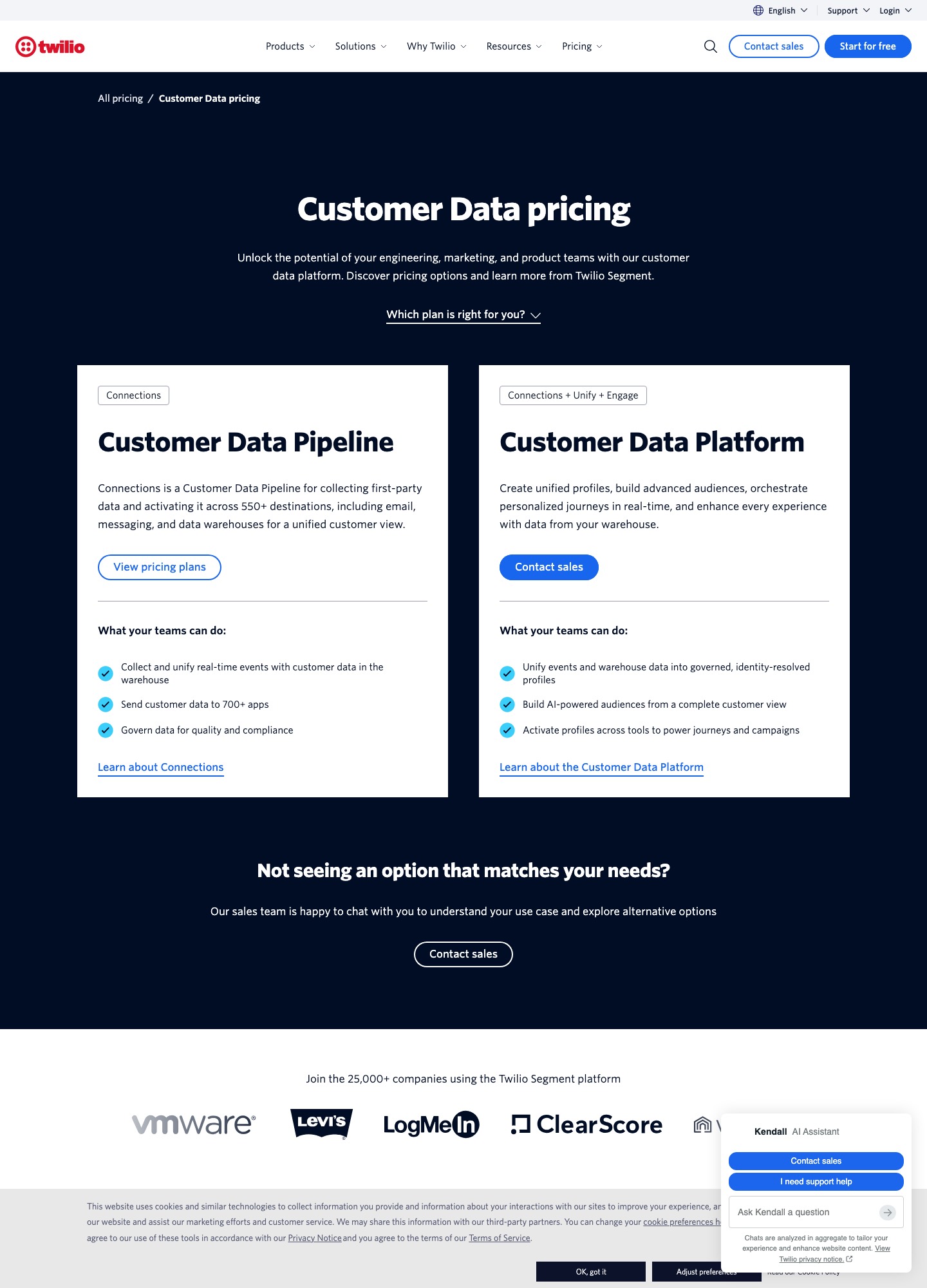
Segment's pricing page (it now lands on Twilio's customer data pricing) names two plans, Customer Data Pipeline and Customer Data Platform, both billed on monthly tracked users and neither with a dollar figure. That gap is why most teams start searching. The four options worth pricing are RudderStack (the nearest event pipeline, with a free tier and a published event ladder), mParticle (an enterprise platform with identity resolution, sold by contract), Hightouch (warehouse-first, strongest on reverse ETL) and PostHog (analytics with a built-in data pipeline, priced per event). Figures were read from each vendor's page on 7 Oct 2026.
By Julian Pryor · Updated 7 Oct 2026
Short answer
If you want to keep collecting events with a Segment-style SDK and pay a published price, RudderStack is the closest: free to 250K events a month, then $265 a month at 1M events. Pick mParticle if consent state and identity resolution are your real requirements and you are an enterprise buyer, Hightouch if your warehouse is already the source of truth, and PostHog if the data mainly feeds product analytics.
Why teams leave Segment
The pricing unit is the first friction. Segment defines a monthly tracked user as "the number of anonymous and logged-in visitors that you track", so anonymous marketing-site traffic counts alongside signed-in users. Its page says both plans are "priced based on monthly tracked users (MTUs)", that "CDP plans use custom volume pricing billed by invoice", and the only payment method listed for both plans is invoice. Overage rates and data retention periods are not published on the page.
The second friction is packaging. On the Customer Data Pipeline plan, Segment's page says Protocols (data governance), audiences, profile enrichment and AI features are add-ons, while the Customer Data Platform bundles Connections, Unify and Engage and is quoted by sales. A team that wants identity-resolved profiles but not journey orchestration has no published middle price to look at.
The third is exit friction. Segment's docs say Replay, which re-sends archived events to a new destination, is available to Business tier customers and "not self-serve", so moving history is a support request rather than a button. Warehouse and S3 storage are the self-serve ways to keep your own copy, and the docs note S3 only copies data sent after you enable it.
What the alternatives cost at 1M, 5M and 10M events a month
Segment publishes no price to compare against, so these are the alternatives' own numbers. Units differ: Segment counts users, RudderStack and PostHog count events. If your app has 10,000 monthly tracked users who each send 100 events, that is 1M events a month; at 50 times the users it is 50M. RudderStack's Growth plan is $265 a month at 1M events ($225 billed annually), $995 at 5M ($845) and $1,675 at 10M ($1,420). Its Free plan covers 250K events.
PostHog's usage tiers: the first 1M analytics events are free, 1-2M cost $0.00005 each and 2-15M cost $0.0000343 each. Anonymous events are therefore $0 at 1M, $50 + 3,000,000 x $0.0000343 = $152.90 at 5M, and $50 + 8,000,000 x $0.0000343 = $324.40 at 10M. Events from identified users add a person-profile charge ($0.000198 for 1-2M, $0.0000697 for 2-15M, first 1M free), which makes 5M identified events $152.90 + $198 + $209.10 = $560.00 and 10M identified $324.40 + $198 + $557.60 = $1,080.00. mParticle and Hightouch publish no prices, so no figure can be given for them.
What to keep Segment for
Segment's page describes Connections as collecting first-party data and activating it across 550+ destinations, with Reverse ETL activating warehouse data into 750+ tools, unlimited seats on both plans and regional infrastructure in Europe and the United States. If your destination list is long and non-standard, destination coverage is the thing to count before leaving: RudderStack lists 200+ cloud destinations on its Free plan, mParticle 300+ integrations and Hightouch 300+ destinations.
The Customer Data Platform plan also bundles identity-resolved profiles, AI-powered audiences and journey orchestration. The alternatives sell those separately or at a higher tier: RudderStack lists Profiles and Data Apps only on Enterprise, and Hightouch lists Customer Studio and Identity Resolution as pick-and-choose products inside its Composable CDP. Stay if you use Unify and Engage and a replacement would mean assembling that stack from several vendors.
Pricing unit and published price, 7 Oct 2026
Read on 7 Oct 2026 from Segment, RudderStack, mParticle, Hightouch and PostHog. Prices are USD per month.
| Product | Pricing unit | Listed price | Free tier or trial |
|---|---|---|---|
| Segment | Monthly tracked users | Pricing on request (quote-based), billed by invoice | Free trial for Connections; no limits published |
| RudderStack Growth | Events per month | 1M $265, 3M $735, 5M $995, 10M $1,675, 25M $2,750 (billed monthly) | Free plan: 250K events; Growth has a 30-day trial |
| RudderStack Enterprise | Events per month | Pricing on request (quote-based) above 25M events | None listed |
| mParticle | Credits drawn against event units of 1M and other metered items | Pricing on request (quote-based); contract credit commitment | No free plan; pricing URL opens a contact form |
| Hightouch | Usage, no MTU limits | Pricing on request (quote-based); paid plans sold through a demo | Basic Reverse ETL: up to 2 active syncs, unlimited seats |
| PostHog | Events, per product | Free to 1M events; 1-2M $0.00005 each; 2-15M $0.0000343 each | Free monthly allowance on every product; no minimums |
Four Segment alternatives and who each is for
1. RudderStack: a published-price event pipeline close to Segment
RudderStack's Free plan is "250K Events/month, $0 free forever" with 16 SDK sources, 200+ cloud destinations, warehouse destinations and Reverse ETL, but also 10 team members, 10 Reverse ETL connections, 5 transformations, a 3-hour warehouse sync and a single tracking plan with 5 events. "Data processing will stop after your second consecutive overage" on Free. Growth adds unlimited team members and tracking plans, a 30-minute warehouse sync, 2 workspaces and 25 Reverse ETL connections; Enterprise adds a 5-minute sync, unlimited transformations, Profiles and Data Apps, HIPAA and SSO.
Its pricing page offers "Segment migration specialists", and the self-hosted project is released under Elastic 2.0. One inconsistency on the page: the pricing FAQ still describes overage fees for a Starter plan that does not appear in the plan table, so ask what overage on Growth costs before you sign.
Trade-off: It prices events rather than users, so a chatty app costs more than the same app does under a user-based plan.
2. mParticle: enterprise consent and identity requirements
mParticle calls itself a hybrid CDP for "multi-channel consumer brands". Its pricing page opens a "Talk with our team" form, and its docs describe value-based pricing: usage is metered across events (Connect, Preserve and Personalize tiers), retention, audience lookback and more, then drawn from pre-paid credits whose rate depends on an upfront commitment. Events are counted in units of 1M, and "mParticle charges for events blocked by Data Planning".
Product differences from its docs: IDSync has five identity strategies with a priority list of identifiers, consent state covers both GDPR consent and CCPA data-sale opt-out and can drive forwarding rules ("Only forward user data if GDPR Consent for 'marketing' is true"), and Warehouse Sync ingests from Redshift, BigQuery, Snowflake and Databricks. There is a Segment migration guide and a paid professional services package; the guide says the APIs and event models are similar to Segment's. Default limits include 1,000 unique event names per workspace.
Trade-off: No public price, a credit commitment up front, and blocked events still count toward billing.
3. Hightouch: teams whose warehouse is already the source of truth
Hightouch sells a Composable CDP in which you "pick from" Reverse ETL Platform, Hightouch Events, Customer Studio, Real-time Personalization, Identity Resolution and Match Booster, with unlimited user seats, plus an Agentic Marketing Platform. Neither plan shows a price: both are "Get a demo", usage-based, with "No MTU (Monthly Tracked Users) limits, and no caps on sources, destinations, or user seats". The one self-serve entry point is the Basic Reverse ETL free tier: up to 2 active syncs, unlimited destinations and unlimited user seats.
Syncs can run on Hightouch, in your warehouse or on your own storage, and the sources listed include Snowflake and Google BigQuery with 300+ destinations. The page lists SAML SSO, ISO 27001, SOC 2 and SOC 3, HIPAA, GDPR and EU region deployment.
Trade-off: It starts from the warehouse, so if you want an SDK that collects browser events directly you need its Events product or another collector.
4. PostHog: product analytics teams that mostly route data to one tool
PostHog bills each product on a free monthly allowance, including 1M analytics events and "10K data pipeline events plus 1M rows". Its pay-as-you-go plan has "no minimums or annual commitments" with per-product billing limits, 1-year retention on free and 7 years on paid, and US (Virginia) and EU (Frankfurt) cloud regions. The prices worked out above show how fast the identified-user charge changes the bill, so price your volume with its calculator.
PostHog's docs list its Segment destination as supporting identify, track, page, screen, group and alias calls, but features such as autocapture, session recording, feature flags, heatmaps and surveys need PostHog's own JavaScript snippet. Its Segment data-warehouse source is in alpha and "does not connect to the event or Profile data plane", so it brings in workspace configuration and metadata, not event history.
Trade-off: It is analytics first: fewer routing destinations than a dedicated CDP, and autocapture events do not reach other tools' destinations.
Leaving Segment: keep your history, then run two collectors
The steps use Twilio's docs on data export options and Replay, RudderStack's advanced migration guide, PostHog's Segment docs and mParticle's Segment migration guide, read on 7 Oct 2026.
- Secure your own copy of history first. Segment's docs list warehouses, an Amazon S3 destination and webhooks as export routes; the docs say S3 "will only include data sent to Segment after you turn on the destination", so enable it now even if you plan to leave in a quarter. Warehouse tables follow a source.collection.property layout, with identifies, users, tracks and one table per event.
- Ask about Replay early. It re-sends archived events to a new destination, but it is for Business tier customers, is not self-serve, and needs a support request naming the workspace, source, destinations and time period. The docs also warn that not all destinations deduplicate, so older data may need removing before a replay.
- Inventory sources, destinations, Protocols rules and audiences. Write down which destinations run in device mode versus cloud mode, since the receiving tool needs each rebuilt, and list the audiences or computed traits that Engage builds today, which you will need to recreate in the new tool or in your warehouse.
- Load the new SDK next to the old one. RudderStack's guide describes a "parallel tracking implementation" that sends to both tools, with conditional loading by user or app version, and recommends removing the Segment SDK only when you are confident. To keep anonymous users linked, its anonymousIdOptions feature reads the anonymous ID from the ajs_anonymous_id cookie that Segment set.
- Plan for old app versions. RudderStack's guide notes that only the latest app version will include the new SDK, and suggests using its Segment source integration for legacy traffic; the guide treats a small remaining share of legacy users as the point to leave Segment fully. For mParticle, the migration guide mentions US1 endpoints and other pods listed on its data hosting page.
- Compare totals and cut over destination by destination. Match event counts and key funnels in the warehouse for two weeks before moving each destination, then cancel the Segment contract only after the last destination and the last legacy source are off it, and keep the exports as your record.
Which one to pick
- Stay on Segment if you use Unify profiles and Engage journeys, depend on its 550+ destinations, or have a Business contract with Replay you still need.
- Pick RudderStack if you want a Segment-style event pipeline with a free 250K events and a published ladder: $265 a month at 1M events, $1,675 at 10M.
- Pick mParticle if consent state, identity strategies and enterprise governance drive the decision and you are comfortable with a credit contract.
- Pick Hightouch if your warehouse already holds clean customer data and the job is activating it, starting on the free 2-sync tier.
- Pick PostHog if the data mostly feeds product analytics, experiments and replay, and you can accept $152.90 at 5M anonymous events (more with identified users).
Related reading: All alternatives pages, Segment vs RudderStack, PostHog vs Amplitude, Customer analytics tools, Analytics stack for SaaS, Integrating your SaaS stack.
Segment alternatives: common questions
Does Segment publish its prices?
Not as dollar figures. Segment's pricing page says both plans are priced on monthly tracked users, that the CDP plans use custom volume pricing billed by invoice, and that Connections moves from a free trial up to Business-tier and CDP plans on custom volume pricing. Contact sales for a quote.
Can I move my Segment history to another CDP?
Partly. Warehouse and S3 exports give you your own copy of the data, and Replay can re-send archived events to a new destination, but Replay is Business tier only and goes through Segment support. PostHog's Segment source brings in workspace metadata, not events.
Is RudderStack cheaper than Segment?
Segment has no published price to compare. RudderStack's published numbers are free to 250K events and $265 a month at 1M events ($225 billed annually). Because RudderStack counts events and Segment counts users, price your own event count before you decide.
Which option is built for GDPR consent handling?
mParticle's docs describe consent state that covers GDPR and CCPA and can filter forwarding and audiences. Hightouch's page lists GDPR compliance and EU region deployment, Segment offers regional infrastructure in Europe and the United States, and PostHog offers EU (Frankfurt) hosting. Each page makes different claims, so match them against your DPA requirements.