Zapier alternatives: six automation tools and how each one meters usage
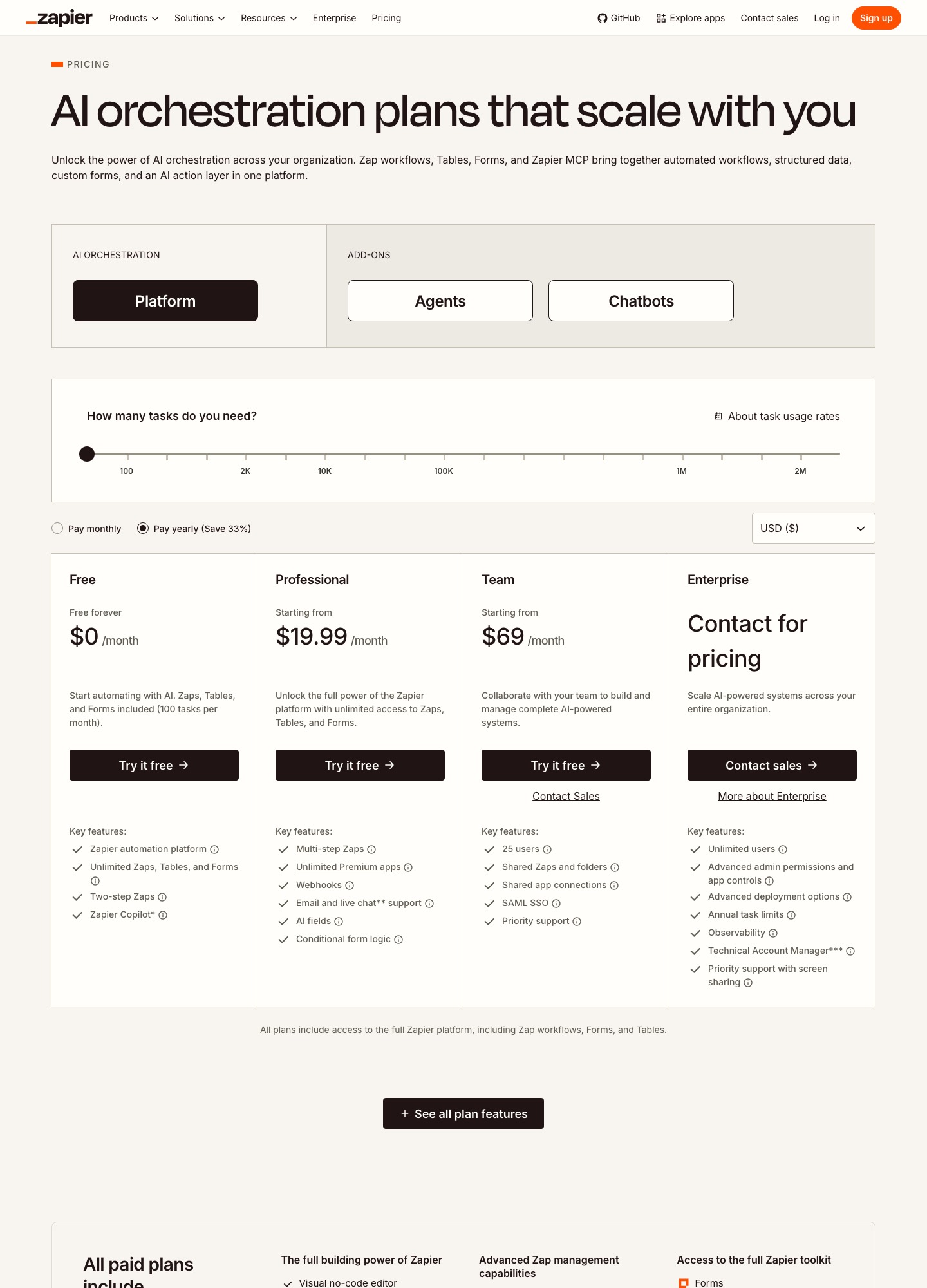
Zapier bills by task, and a task is any successful action step, so the people who leave it are usually running multi-step workflows at volume. The alternatives that fit that problem are Make (credits per module action, with a $9 entry plan), n8n (priced per whole workflow execution, with a self-hostable edition), Pipedream (code-friendly, billed in compute credits), Activepieces (flat monthly plans with a free tier) and two quote-based enterprise platforms, Workato and Tray. Zapier's pricing page lists Free at 100 tasks a month, Professional from $19.99 and Team from $69. Every number below was read from a vendor page on 7 Oct 2026.
By Julian Pryor · Updated 7 Oct 2026
Short answer
Stay on Zapier if your workflows are short, your task volume is low, and the 9,000+ app directory is what you need. Move to Make if you want the cheapest published entry plan for step-heavy flows, to n8n if you want to pay per run instead of per step or self-host, to Activepieces if flat monthly prices and an on-premise option matter, and to Pipedream if your team writes code. Workato and Tray are for companies that already buy through a sales process.
Why teams leave Zapier
The unit is the first reason. Zapier's page says "Tasks are used when a Zap successfully moves data or completes an action for you automatically", and its help article lists every successful action step as a task, including successful steps inside an error-handler path and previously successful steps that run again when you replay a whole Zap run. Triggers, Filter and Paths steps are not tasks, and Formatter is on the list of built-in apps that are not billed. So a Zap with a trigger, a Filter and three actions that runs 2,000 times uses 3 x 2,000 = 6,000 tasks, assuming every run passes the Filter.
The second is overage. The page says "Pay-per-task billing is charged at a higher per-task rate than your base subscription tasks", and the Professional price is a "Starting from" figure at the entry task tier, with the page noting that a higher task tier lowers the cost per task. You read your own price from a slider that runs from 100 tasks to 2M, so the $19.99 in headlines is not the price of a busy account. Newer products carry their own rates: the help article says Zapier MCP charges 2 tasks per successful tool call.
The third is plan gating. SAML SSO, 25 users and shared Zaps and folders sit on Team from $69, advanced admin permissions and annual task limits on Enterprise, and the Free plan limits you to two-step Zaps and 100 tasks. Zapier's own docs say the JSON export and import of Zaps needs a Team or Enterprise plan, so a Professional customer cannot use that JSON route.
What Zapier costs and how the alternatives meter the same work
Zapier's headline plans on 7 Oct 2026, with Pay yearly selected, are Free at $0 (100 tasks a month, two-step Zaps), Professional from $19.99 a month (multi-step Zaps, unlimited premium apps, webhooks, AI fields), Team from $69 a month and Enterprise on request. A 14-day Professional trial needs no card. Taking the 6,000-task workflow above, Zapier's price depends on where the slider lands; I did not read the slider price at 6,000 tasks, so it is not quoted here.
The same workload elsewhere. On Make, each module action counts as one credit, so 3 action modules x 2,000 runs = 6,000 credits, inside the 10,000 credits that Core includes at $9 a month on annual billing ($10.59 monthly). On n8n, the unit is a whole run: 2,000 executions fit inside Starter's 2.5K at $20 a month billed annually, regardless of steps. On Activepieces, Plus is a flat $20 a month for 10,000 credits and Team is $200 a month for 50,000, with $0.007 per credit beyond.
Scale it up and the picture changes. At 20,000 runs a month the same Zap needs 60,000 tasks, while n8n goes from Pro (10K executions, $50) to Business (40K executions, $800 on annual billing, self-hosted only), a steep step. That is a reason to compare each tool's tier boundaries at your volume, not just its entry price.
What to keep Zapier for
Zapier lists 9,000+ app integrations. Make lists 3000+ apps, Pipedream 3,000+ connectors, Workato 1,200+ pre-built connectors and Tray 700+, so a long-tail app in your stack may only exist in Zapier. List every app your Zaps touch and look each one up in the new tool's directory before you commit.
Stay if your Zaps are short, if triggers and filters do most of the work and cost no tasks, or if nobody on the team wants to learn a new builder. Leave when the task meter, not the app list, is what grows your bill.
Entry prices and billing units, 7 Oct 2026
Read on 7 Oct 2026 from Zapier, Make, n8n, Pipedream, Activepieces, Workato and Tray. Units differ, so compare how each one counts your workflow.
| Tool | Billing unit | Free plan | First paid plan | Quote-based tier |
|---|---|---|---|---|
| Zapier | Task: each successful action step | 100 tasks a month, two-step Zaps | Professional from $19.99 a month (Pay yearly) | Enterprise: contact for pricing |
| Make | Credit: each module action | 1,000 credits a month, 2 active scenarios | Core $9 (annual) or $10.59 (monthly) for 10k credits | Enterprise: custom pricing |
| n8n | Execution: a whole workflow run | None hosted; Community Edition self-hosted | Starter $20 a month billed annually, 2.5K executions | Enterprise: contact sales |
| Pipedream | Credit: 1 per 30 seconds of compute | Free, development only | Startup $99 annual or $150 monthly, 10,000 credits | Business: custom, annual contract |
| Activepieces | Credit | 1,000 credits a month, up to 5 users | Plus $20 a month flat, 10,000 credits | Ultimate: talk to sales |
| Workato | Tasks, per contract | No free plan | No prices published | All four editions |
| Tray | Tasks, per contract | No free plan | No prices published | Pro, Team, Enterprise |
Six Zapier alternatives and who each one is for
1. Make: cheap entry for step-heavy visual flows
Make's Free plan gives 1,000 credits a month with no time limit, 2 active scenarios, a 15-minute minimum interval between runs and 7 days of execution logs. Core, Pro and Teams are priced for 10k credits: $9, $16 and $29 a month billed annually, or $10.59, $18.82 and $34.12 billed monthly. Core adds unlimited active scenarios, scheduling down to the minute and the Make API; Pro adds priority scenario execution, custom variables and full-text log search; Teams adds team roles and shareable scenario templates.
Credits expire at the end of the term, and when they run out scenarios stop until you add more; extra credits come in bundles of 1,000 or 10,000 at the fixed price in your subscription. The page's FAQ says credits replaced operations as the billing unit from August 27. Error handler modules and the router are not counted.
Trade-off: Scenarios halt when credits run out, and the page text does not state a per-credit overage rate, so you need to size the credit tier above your peak month.
2. n8n: pay per run, with a self-hosted option
n8n prices by "monthly workflow executions, regardless of complexity", and defines an execution as "a single run of your entire workflow", however many steps it has. Starter is $20 a month billed annually for 2.5K executions, Pro $50 for 10K executions with 3 shared projects and admin roles, Business $800 for 40K executions with SSO, LDAP and Git version control (self-hosted only), and Enterprise adds an external secret store, log streaming and a support SLA. A standard self-hosted version is available on GitHub, and companies under 20 employees can ask about a Start-up Plan with 50% off Business.
For a 10-step workflow run 2,000 times that is 2,000 executions, not 20,000 steps, which is the clearest difference from Zapier's task model.
Trade-off: There is no hosted free plan, the Starter tier has forum support only, and the jump from Pro to Business is $50 to $800.
3. Pipedream: developers who want code in their workflows
Pipedream's Free plan is development only: every feature, 3,000+ connectors, unlimited team members and community support, but no production environment. Startup is $99 a month billed annually or $150 monthly, includes running in production, 100 users, 10,000 usage credits and email support, then $0.012 per extra credit and $2 per extra user. A credit is 1 credit per 30 seconds of compute, so billing follows run time, not steps.
SSO, SCIM, HIPAA and dedicated static egress IPs are Business-only on an annual contract, while SOC 2 Type 2 and GDPR are listed on all plans. The pricing page does not describe execution history, retries or self-hosting.
Trade-off: Production use starts at $99 a month on annual billing, which is higher than Make Core or Activepieces Plus, so it pays off for code-heavy workflows rather than simple ones.
4. Activepieces: flat monthly prices and on-premise hosting
Activepieces lists Free at $0 with 1,000 credits a month, unlimited flows and up to 5 users; Plus at $20 flat a month for 10,000 credits and 5 users; Team at $200 flat for 50,000 credits, 25 users, SSO and standard roles; and Ultimate on request with dedicated workers, SCIM, Git sync and audit logs. Going over costs $0.007 per credit on Plus and Team, while Free waits until the next day when credits reset.
The page lists hosting as cloud or on-prem on every plan, and describes running it on your own servers or air-gapped for enterprise. An Embed offer for white-labelling starts from $36k a year.
Trade-off: The pricing page does not describe execution history, retries or error handling, and Team's $200 is a big step from Plus at $20.
5. Workato: enterprise integration with governance
Workato's page lists four editions with no prices: Standard (application integration, recipe lifecycle management, dev, test and production environments, SAML SSO and MFA, 30-day log retention), Business MCP, Enterprise MCP (data pipelines, event streams, 90-day log retention, enhanced security) and Workato ONE (Agent Studio, a knowledge base). It lists 1,200+ pre-built connectors and unlimited workspaces and users, and says its "pricing and plan structures may vary based on your contract terms and when you joined".
Usage is tracked as task consumption in a Usage Dashboard, and an on-premises gateway is required to reach on-premise systems.
Trade-off: No published price or free plan, so it is a sales-led purchase aimed at larger integration programmes.
6. Tray: multi-department automation by contract
Tray's page lists Pro (3 workspaces, 7-day insights and log retention, 700+ connectors), Team (20 workspaces, 30-day insights, expandable log retention, log masking) and Enterprise (unlimited workspaces, 180-day insights, advanced on-premise, SSO, HIPAA, regional hosting, log streaming). No prices are published; every plan card leads to a demo or a sales contact. Usage is metered in Tasks that cover integration, automation, MCP and agents, and add-ons such as SSO, HIPAA and regional hosting are sold separately.
Observability, audit trails and data tables are included on all plans, according to the page.
Trade-off: Like Workato, there is no free plan and no task price to model, and the page does not describe retries or error handling.
Moving off Zapier: what exports and what you rebuild
Zapier's help article Import and export Zap workflows and its guide to task usage were the docs used for the steps below, read on 7 Oct 2026.
- Inventory every Zap with its trigger app, its action steps and how often it runs. Count tasks the way Zapier does: successful actions only, not triggers, Filter, Paths or Formatter, so you know what each Zap costs today and what it would use in a per-credit or per-execution tool.
- Export what you can. The help article says Zap workflows can be exported as a JSON file from Settings, under Security and data, and imported again, but only on Team or Enterprise plans. The file is meant for moving Zaps between Zapier accounts, so plan to rebuild each workflow by hand in Make, n8n, Pipedream or Activepieces rather than import it.
- Keep the history. Zapier has a separate article on exporting your Zap history; download it before you cancel so your team can look up what ran and when.
- Re-point inbound webhooks. Any app that posts to a Zapier catch-hook URL (a billing system, a form tool, your own backend) must be changed to the new tool's webhook URL, and secrets or signature checks need to be set up again in the new tool.
- Re-authorise every app connection in the new tool, and confirm each app exists in its directory. Connection credentials live inside Zapier, so each one is a fresh sign-in.
- Run in parallel on a test destination first, then switch the trigger: turn the Zap off and the new workflow on in the same window, keep the old Zap unpublished rather than deleted for one full billing cycle, and cancel the Zapier plan only after that cycle has closed without surprises.
Which one to pick
- Stay on Zapier if you run short Zaps at low volume, rely on its 9,000+ apps, and the Free or Professional plan covers your task count.
- Switch to Make if the bill is driven by multi-step workflows and you want an entry price of $9 a month on annual billing for 10k credits.
- Switch to n8n if you want to pay per run, regardless of steps, or run it yourself from the Community Edition on GitHub.
- Switch to Activepieces if you want flat monthly prices, 10,000 credits for $20 and an on-prem option.
- Switch to Pipedream if your team is comfortable writing code and wants usage billed by compute time; choose Workato or Tray only when a sales-led contract and enterprise governance are the point.
Related reading: All alternatives pages, All comparisons, Integrating your SaaS stack, The essential SaaS tools stack, Free SaaS tools for startups.
Zapier alternatives: common questions
What counts as a task in Zapier?
Zapier's help article lists all successful action steps, successful steps inside an error handler path, and previously successful steps that run again when you replay a whole Zap run. Triggers, Filter and Paths steps do not count, and Formatter is listed with the built-in apps that are not billed. Zapier MCP charges 2 tasks per successful tool call.
Which Zapier alternative is cheapest for step-heavy workflows?
On published prices, Make Core at $9 a month on annual billing covers 10k credits, and n8n Starter at $20 a month billed annually covers 2.5K executions that can contain any number of steps. Activepieces Plus is $20 flat for 10,000 credits. Which is cheapest depends on whether you run many short workflows or fewer long ones, so convert your own run counts using the table.
Can I export my Zaps and import them into another tool?
Zapier documents JSON export and import of Zap workflows only for Team and Enterprise plans, and the format is meant for Zapier accounts. Plan to rebuild each workflow in the new tool. Export your Zap history separately so you keep a record of past runs.
Is there a free alternative to Zapier?
Make's Free plan has 1,000 credits a month and 2 active scenarios, Activepieces' Free plan has 1,000 credits and up to 5 users, and n8n's Community Edition is a self-hosted version available on GitHub. Pipedream's Free plan is development only, with no production environment. Zapier's own Free plan is 100 tasks a month and two-step Zaps.